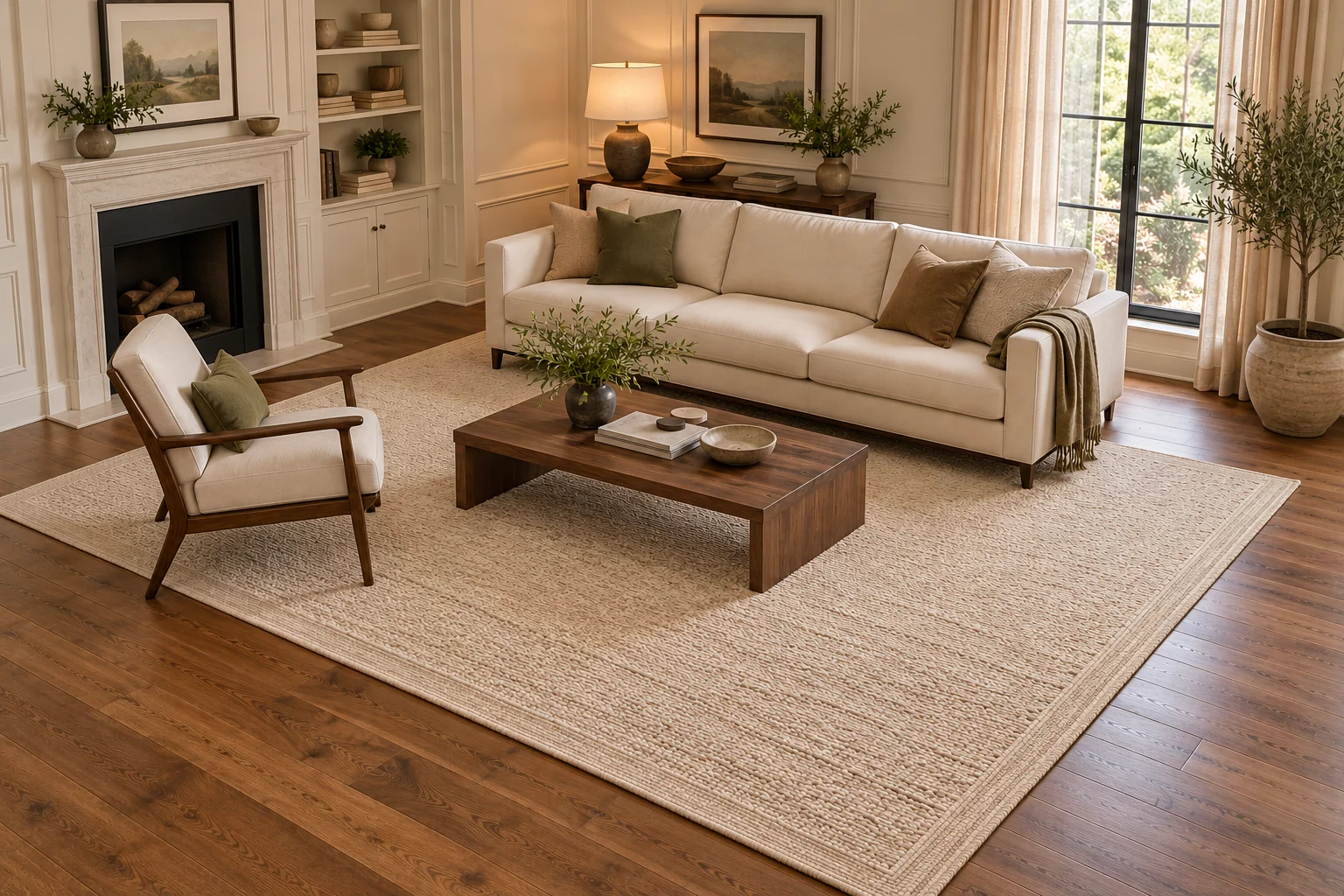
A rug changes how the furniture in a living room fits together. When it reaches beneath the seating, the sofa, chairs, and coffee table begin to feel like one welcoming place to settle. A beautiful rug that stops short of everything can leave those same pieces looking disconnected.
The most reliable way to choose a size is to arrange your furniture first, decide how much of it you want on the rug, and measure that footprint. Standard sizes give you options to test. Your actual seating arrangement tells you which one works.
Start with the seating area
Place the sofa and chairs where you genuinely want to use them. Check the view toward the television or fireplace, the distance for conversation, and the routes through the room. If the chairs are too far away to feel comfortable, bring them closer before measuring for a rug.
Measure the full width and depth of this grouping, including projecting arms and the complete length of a chaise. Note where the furniture feet sit underneath. Two sofas with the same outside dimensions can need different amounts of rug beneath them because their legs are in different positions.
In an open-plan room, concentrate on the living area rather than trying to center the rug across the entire floor. A reading chair elsewhere in the room can have its own place. It does not need to be pulled into the main arrangement simply to touch the same rug.
Give the sofa and chairs a shared footprint
Front-legs-on placement is a useful starting point when you want to connect the seating while leaving more floor exposed. Slide the rug beneath the sofa and the chairs that belong to the conversation area, with their front feet comfortably inside its edges.
Let the rug extend beyond the sofa arms so it reads as a base for the furniture. Check each chair individually, especially if it sits at an angle. A chair’s nearest foot touching a corner of the rug will not give the same stable, settled placement as both front feet resting fully on it.
For example, an 8 × 10 foot rug with its 10 foot side along an 84-inch sofa leaves 18 inches beyond each arm when centered. In the illustrated arrangement, the rug reaches 12 inches beneath the sofa front and also catches both chairs’ front feet. Those measurements describe this layout; a deeper sofa or wider chair arrangement could need a different size.
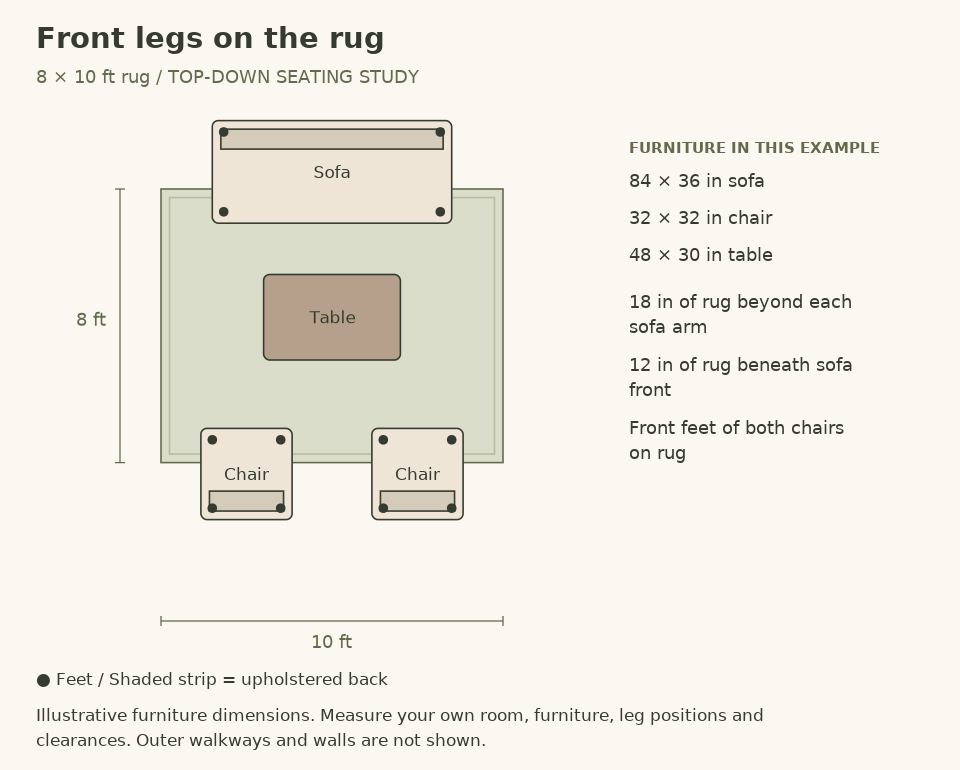
An 8 × 10 ft rug runs its 10 ft side along an 84 in sofa, leaving 18 in beyond each arm. The rug reaches 12 in under the sofa and chair fronts; all front feet sit inside its edges.
Use a larger rug to hold a floating arrangement
When the seating sits away from the walls, placing every sofa and chair leg on the rug can give the group a particularly composed outline. Measure from the back of the sofa to the backs of the facing chairs, then allow some rug to remain visible beyond them.
Our compact all-on example uses a 9 × 12 foot rug turned with its 12 foot length running from sofa to chairs. It accommodates an 84 × 36 inch sofa, two 30 × 30 inch chairs, and a 44 × 24 inch coffee table. There are 18-inch gaps between the table and the seating fronts. Test those gaps against your own reach and movement; they are not a main walkway allowance.
Notice that orientation matters as much as the size label. The same rug turned sideways would not contain this arrangement. Larger lounge chairs, deeper seating, and extra tables all change the footprint, so check every piece you intend to include.
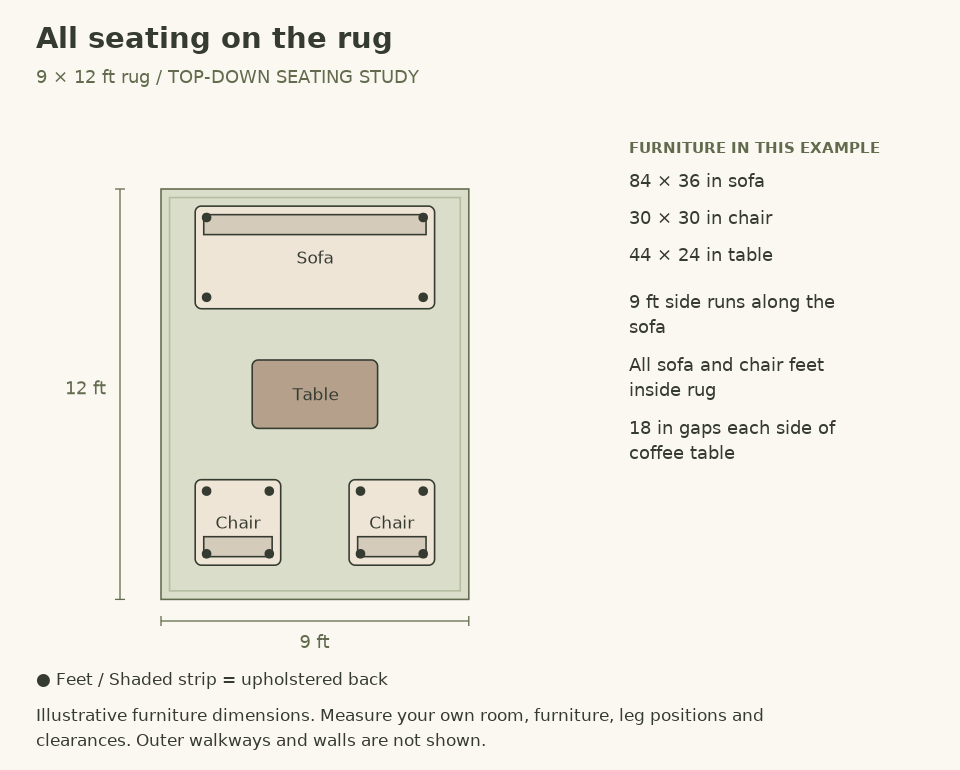
A compact grouping fits fully on this 9 × 12 ft rug with its 12 ft length running from sofa to chairs. The 84 × 36 in sofa, two 30 × 30 in chairs and 44 × 24 in table are specific to this example.
Measure a sectional as a complete shape
A sectional needs a rug that responds to its whole outline. Measure the longest back, the full chaise depth, and the space inside the seating where the coffee table will sit. Include any separate ottoman in its usual position.
For a sofa with a chaise, try the rug’s longer edge parallel to the long sofa back. Bring it beneath the front seating feet and both feet at the chaise tip. Avoid choosing only for the open rectangle beside the chaise, which can leave the projecting end disconnected from the rug.
The sectional diagram uses a 108-inch-wide sofa with a 72-inch overall chaise depth and a 9 × 12 foot rug. The rug’s 12 foot edge follows the sofa back, with the chaise-tip feet securely on it. This is a measured example, not a size recommendation for every sectional. A corner sectional with two long seating runs, or a U-shaped configuration, needs its own footprint test.
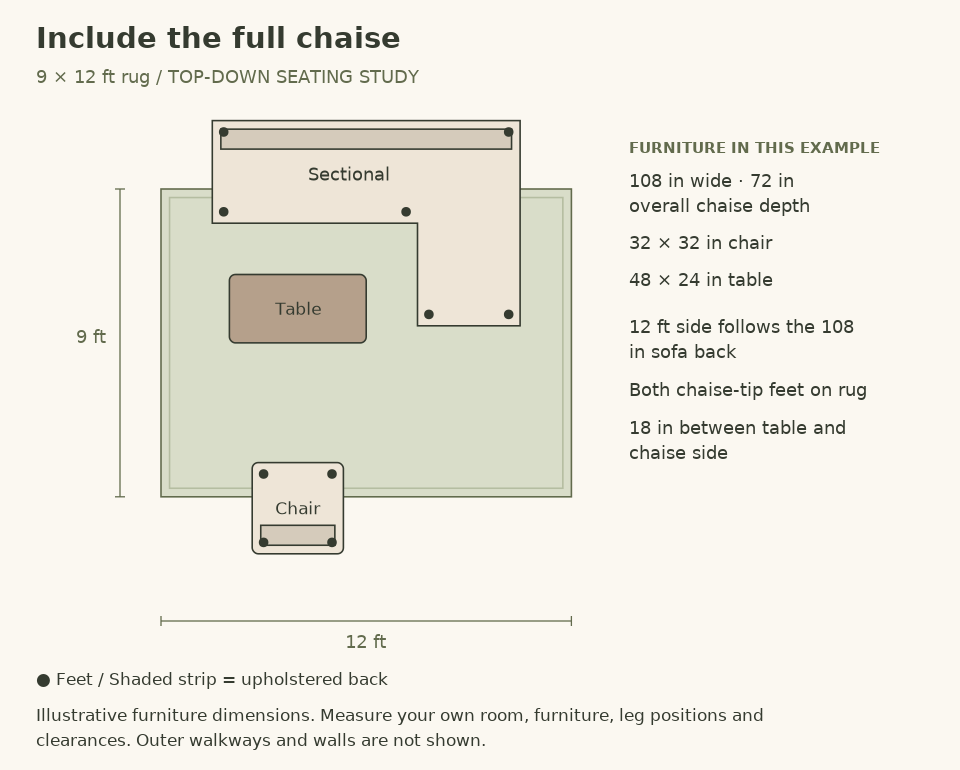
For this 108 in wide sectional with a 72 in deep chaise, the 12 ft rug edge follows the long sofa back. The sofa front feet, both chaise-tip feet and the chair front feet sit on the rug.
Tape out the actual dimensions
Once you have a likely size, mark its outline with small pieces of low-tack tape suitable for your floor finish. Test the tape discreetly first. Compare the marked rectangle with the rug’s listed dimensions, including any fringe that affects the available space. Do not assume every rug sold under the same standard size has identical measurements.
Leave the furniture in position and check all four corners of the proposed rug. Sit down, stand up, and reach for the table. Move the chairs as you normally would. Open a recliner fully if you have one, and check the space needed for a swivel chair to turn.
Photograph the taped outline from the doorway. If you are deciding between two sizes, photograph each from the same spot. The comparison will show where the smaller option loses contact with the seating or where the larger one starts to crowd another part of the room.
Protect the routes through the room
A visible border of floor can frame a rug beautifully, but it does not need to be identical beside every wall. An off-center seating area may leave more floor on one side for the route to a doorway. Preserve that useful space rather than shifting the whole arrangement simply to make the borders match.
Walk the routes to doors, windows, storage, and neighboring rooms. Check them with drawers open and with people seated. Allow the space your household needs, including mobility aids; a decorative floor border is not proof of an accessible route.
Where a door passes over the rug, measure the available clearance and compare it with the combined rug and pad thickness. Check the entire swing, since the floor may rise beneath part of it. Keep edges flat and avoid a rug corner that curls into a busy path. Follow appliance guidance around heaters and keep vents unobstructed.
Include the pad in your plan
Choose a pad suited to both the rug and the floor beneath it, following the flooring and pad manufacturers’ compatibility guidance. The right pad can help reduce movement and add cushioning, but a thick pad can also affect door clearance and how furniture sits.
Use the maker’s sizing instructions so the pad stays hidden inside the rug edges. Once everything is laid down, check that the seating feels stable, the rug lies flat, and the edges settle neatly. Include the pad in your budget from the beginning.
Spend on the size you will enjoy living with
If your preferred rug is expensive in the size the room needs, compare simpler patterns and different constructions before shrinking the footprint. Check care requirements and return conditions as carefully as color. A less elaborate rug that works with the furniture may be the more satisfying purchase.
You can also reconsider the layout before buying. Bringing a chair closer or moving an occasional table can make the seating area more coherent without replacing everything. If you already own a small rug you love, it may find a better home beside a reading chair or in another room.
Once the size is settled, use color and texture to connect it with the rest of the space. Our guide to making a neutral living room feel warm explores those finishing layers. Begin with the tape measure, then choose the rug you want to come home to.