WESTMONT may earn a commission if you buy through links in this article.
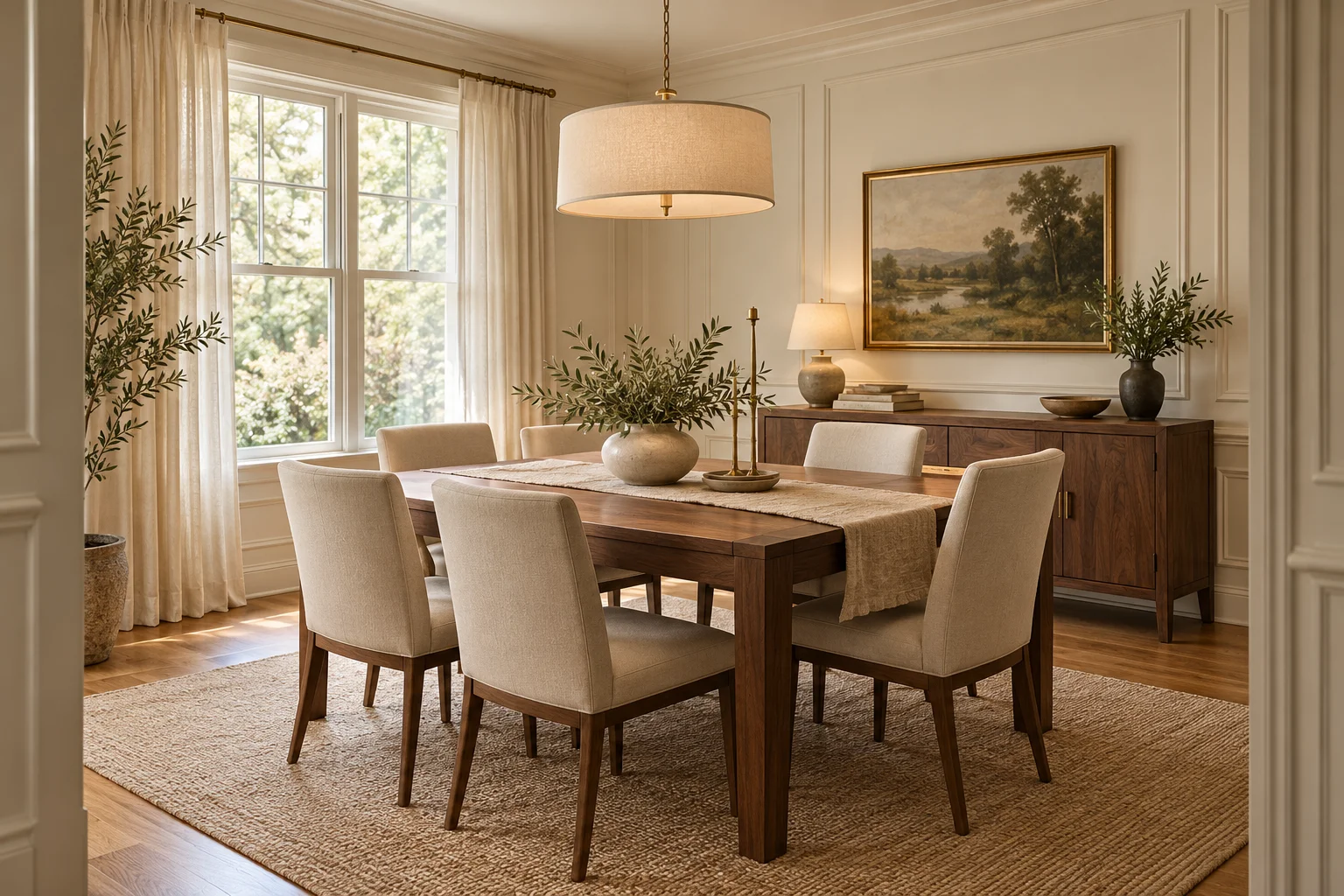
A dining room feels inviting when the table is easy to gather around and the details work together. Soft fabric, comfortable chairs, and a gentle pool of light can give an ordinary room a considered feel. You can often create that feeling with the furniture you already own.
Before buying anything, clear the table and look at the room from the doorway. Notice what feels distracting, what seems out of proportion, and what you genuinely enjoy. Keep the useful pieces, then work through these seven changes one at a time. Most begin with a small adjustment, a cupboard search, or a little rearranging.
1. Give your table linens a tailored finish
A freshly pressed tablecloth can change the impression of an older table immediately. Start with a cloth, runner, or set of napkins you already have, and follow the care label when washing and ironing. Smooth folds and an even arrangement help an inexpensive fabric feel thoughtfully chosen.
Choose the amount of coverage your table needs. A runner leaves a favorite tabletop visible; a cloth brings a softer outline to a room with several hard surfaces. Test the drape with someone seated so loose fabric does not bunch in a lap or interfere with chair arms. Keep the edges balanced around the table.
For an easy palette, try warm white, oatmeal, or a muted olive that relates to something else in the room. A quiet stripe can add interest without competing with patterned dishes. You do not need all three layers of cloth, runner, and placemats. Use the combination that looks settled and still leaves comfortable space for plates.
2. Make the chairs feel like a group
Chairs do not need to be identical to look intentional. A shared color, similar silhouette, or repeated seat material can connect a mixed collection. Look for the relationship already present before deciding that the whole set needs replacing.
Try arranging matching chairs opposite each other, with a different pair at the ends of a rectangular table. For a round table, distribute contrasting chairs so one side does not feel noticeably heavier. Sit in every position to check comfort and make sure arms fit beneath the table where you want chairs to tuck in.
Clean the frames using care guidance appropriate to their finish, and address loose or damaged parts before using them. If you already use removable seat cushions, coordinating their covers can bring several chair styles together. Check the fit and keep cushions securely in place. Skip bulky additions that make seats awkward; the room should remain comfortable through a long dinner, not just look tidy from the doorway.
3. Bring the lighting into proportion
The light above the table helps define the dining area, especially in an open-plan home. Notice how your existing fixture relates to the table underneath it. A compact shade may disappear over a long table, while an oversized fitting can dominate a small corner.
Before replacing a fixture, check the light itself. Compatible bulbs with a consistent, warm appearance can make the room feel more coherent. If you already have dimmable lighting, adjust it for a meal while keeping enough light to see faces and food comfortably. Follow the fixture’s bulb and wattage requirements.
Evaluate any pendant from both seated and standing positions. It should feel connected to the table without obstructing conversation or becoming something people have to duck around. Check the manufacturer’s installation guidance and use a qualified professional for electrical changes. If your current fitting works well, there is no need to replace it: a lamp on an existing sideboard can add a softer layer, with its cord kept clear of walking routes.
4. Size the rug for the chairs as well as the table
A dining rug looks most settled when it accommodates the way the room is used. The table’s footprint is only the starting point. Chairs need space to move when someone sits down, stands up, or shifts during a meal.
Pull each chair out to a comfortable position and check whether its legs remain on the rug. Include the end chairs and your usual table extension if you regularly use one. A rug edge caught beneath the back legs can make moving a chair frustrating, even when the arrangement looks balanced with every seat tucked in.
Before buying a larger rug, mark its proposed outline with painter’s tape and test the room, including doors and nearby storage. Consider a flatter surface that allows chairs to slide easily, and check the maker’s cleaning guidance for everyday spills. If a suitably sized rug would crowd the room or stretch the budget, enjoy the bare floor. A clean, open dining area can feel beautifully finished without another layer.
5. Give everyday clutter a home behind closed doors
Table linens, serving bowls, candles, and spare glasses are easier to enjoy when they have a place to return to. Start by clearing a shelf in an existing cabinet or reorganizing a cupboard nearby. Store the pieces you use most within easy reach, and leave enough space to put them away without a careful balancing act.
If the room genuinely needs more storage, Homary’s 39-inch blue-and-teal sideboard with scalloped detailing and gold-colored trim offers two doors and an adjustable shelf, with a stronger color accent for an otherwise neutral scheme. It was listed at $599.99 and available to order when checked on October 10, 2026; price and availability may change.
Treat it as an optional furniture investment. Check the full dimensions, door clearance, and storage capacity against your room and belongings before deciding. If your existing storage already does the job, skip the purchase. Clear part of its top for serving, and let a single decorative piece provide the finishing touch.
6. Keep the centerpiece low and easy to move
A centerpiece should leave room for the people around it. Try a shallow bowl of fruit, a small ceramic vessel, or a few short stems in a vase you already own. Sit down on both sides of the table and check that everyone can see across it comfortably.
Scale the arrangement to the usable tabletop. A long table may suit a loose grouping, while a compact round table often needs only one piece. Leave space for water, serving dishes, and the things that appear during an ordinary meal. Move the centerpiece to a sideboard if the table needs to work harder that evening.
Repeated small purchases can make a table feel crowded surprisingly quickly. Before adding another ornament, try removing one. An everyday bowl with an interesting shape can provide enough texture on its own. Keep the arrangement simple enough that clearing and resetting the table takes very little effort.
7. Make your everyday place settings feel cohesive
Bring out the dishes you use most and arrange one complete setting before doing the whole table. Choose a few details to repeat: a plate shape, a glass style, or napkins folded the same way. Existing white dishes and clear glasses make an easy foundation, even when they came from different sets.
If you enjoy color, introduce it through one repeatable detail, such as olive napkins or patterned side plates. Leave enough space between settings for elbows and shared dishes. Keep the pieces you actually need for the meal, and store special-occasion extras until they are useful.
Finish by looking across the room again. Smooth the fabric, align the chairs, and clear anything that belongs elsewhere. These small habits support the same sense of balance explored in our guide to making your home look expensive. Start with the change that solves your room’s most noticeable problem, then live with it before spending more. A dining room feels finished when it is both pleasing to look at and ready to use.