WESTMONT may earn a commission if you buy through links in this article.
A small bedroom can feel generous in the ways that matter: somewhere to move comfortably, put down a book, and settle into bed without negotiating a collection of obstacles. You can often get there with the furniture you already own.
Before deciding that the bed is too dark or the dresser too substantial, look at what surrounds them. A crowded doorway, curtains covering the daylight, and several competing bedding patterns can make familiar pieces feel heavier than they are. Start with the layout, then simplify the room’s largest surfaces. The aim is a comfortable bedroom with a little more breathing room.
Start at the doorway
Stand just outside the room and notice where your eye lands. Ideally, you see an inviting bed and a clear way to reach it. A laundry basket, a chair covered in clothes, or the corner of a dresser projecting into the entrance can interrupt that first view.
Move the loose items first. Put away anything that belongs elsewhere and empty the chair before considering a new arrangement. Photograph the room from the doorway, then take another picture after this simple reset. The comparison helps separate a furniture problem from an accumulation problem.
Look at the floor as well as the surfaces. A few clear patches around the bed make its outline easier to read. You do not need to leave every corner empty, but each item on the floor should earn its place through daily use.
Give movement priority over symmetry
Measure the bed frame, including a projecting headboard or footboard, and the full depth of your dresser. Then measure the room, marking doors, windows, outlets, and built-in storage. A quick sketch is enough to test a different arrangement before moving heavy furniture.
The best position for the bed is usually the one that leaves useful access to sleeping places and storage. Perfect centering on a wall is less important than opening a wardrobe or getting into bed comfortably. A small shift can sometimes improve a tight route without making the room feel unbalanced.
Check the arrangement with drawers extended and doors open. Walk from the entrance to the bed and wardrobe, and allow the space your household actually needs, including any mobility aids. If two people share the bed, consider both sides. Pushing it into a corner may expose more floor while making everyday use harder.
Temporarily move an occasional chair or end-of-bed bench to another room if it blocks the route. Try living without it for a few days. Keep essential access, vents, heaters, and any required emergency exit clear; a pleasing photograph is only useful if the room works.
Let the bed become one calm surface
The bed occupies a large part of a small bedroom, so its bedding has an outsized effect. Several high-contrast prints, scattered cushions, and a bulky throw can break that surface into lots of small visual pieces.
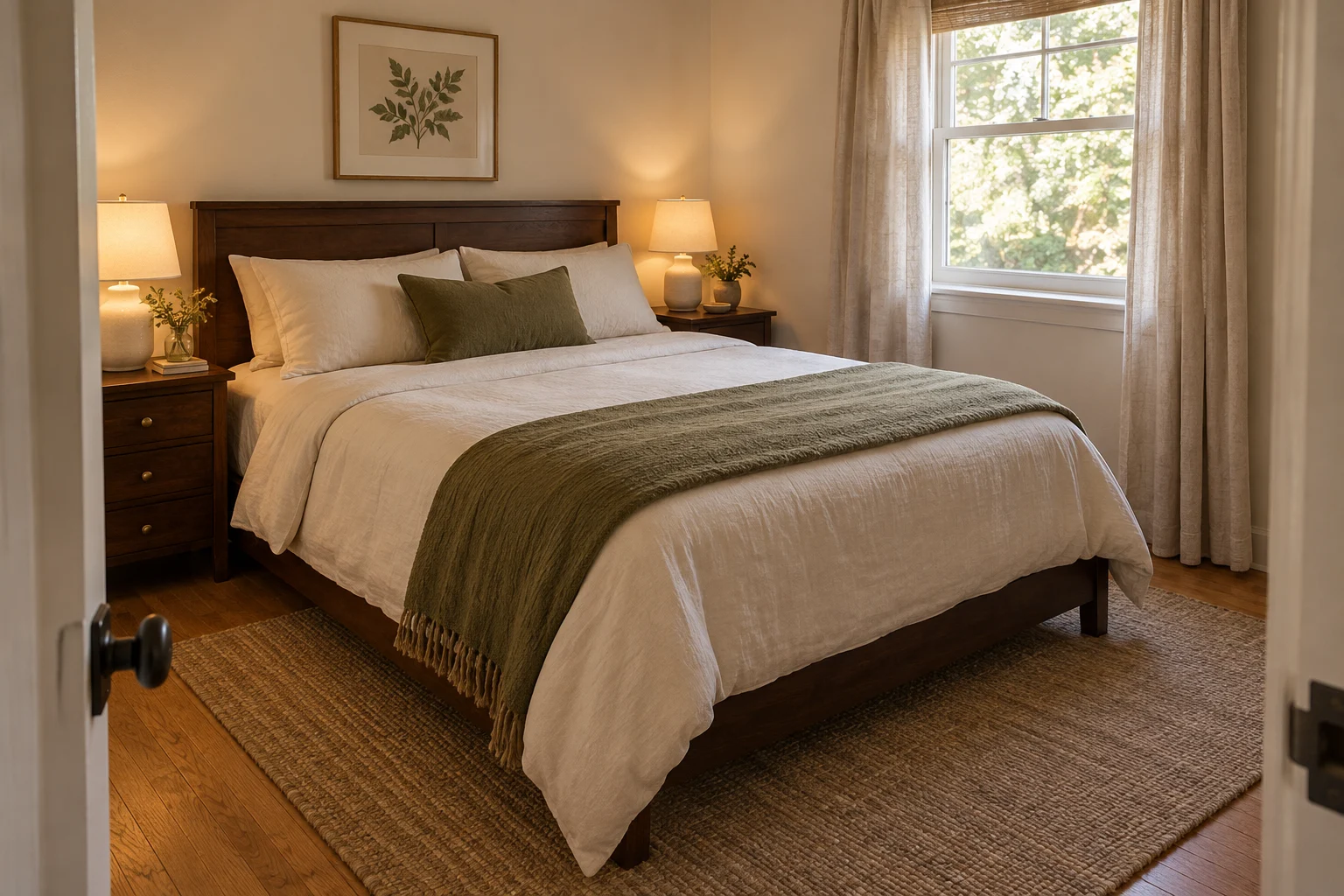
Start with your simplest duvet cover or quilt. Soft ivory, oatmeal, or a muted color already present in the room can create a quieter foundation. Add the pillows you use and perhaps one decorative cushion. Fold a throw neatly across the lower portion of the bed rather than letting it spill into the walking space.
Texture keeps this restrained approach inviting. Washed cotton, a subtle woven stripe, or a gently rumpled linen finish can bring interest without a crowded pattern mix. Make the bed with layers that suit how you sleep; there is no need to build a display you have to dismantle every night.
Keep the dark wood and lighten its surroundings
A walnut dresser or dark wooden bed can give a small bedroom warmth and character. You do not have to replace it, paint it, or disguise it to make the room feel more open.
Instead, reduce the competing dark areas around it. Try pale bedding against the headboard, a light lampshade on the nightstand, and a simpler arrangement above the dresser. Repeat one or two warm tones so the furniture feels connected to the rest of the room.
Give the dresser top some visible space. A lamp, a shallow dish for everyday jewelry, and one picture may be enough. If a dark bed, dresser, curtains, and bedding all merge into one heavy grouping, start by changing the easiest textile using something you already own. Keep the pieces you love as the room’s anchors.
Reveal more of the window
Daylight is easily lost behind curtains that sit over the glass even when they are open. Pull the panels back and see how much window remains covered. If the rod and wall space allow, arranging the fabric farther to the sides can make the window feel more generous.
For a future adjustment, hanging curtains higher can create a longer vertical line. Check the available wall, ceiling details, bracket placement, and curtain length before moving any hardware. Panels that just meet the floor tend to be easier to manage in a compact room than fabric puddled beside the bed.
Keep the privacy and light control you need for sleep. Airy curtains may work as a daytime layer, but they do not replace an effective blind or lined panel where darkness matters. Keep fabric clear of heaters and follow their clearance guidance. Our guide to hanging curtains to make a room look taller walks through the height and width decisions in more detail.
Spread the evening light
A single bright ceiling light can leave the edges of a bedroom feeling dim and uninviting. Try the lamps you already own in different positions before buying anything. A shaded bedside lamp and a gentle pool of light on the dresser can make more of the room feel usable after dark.
Keep light sources warm and comfortable for the way you use the room. Sit in bed to check whether a bulb is exposed at eye level and whether the shade leaves enough light for reading. Use bulbs compatible with the fixture and its stated limits.
Wall-mounted lighting can free a crowded bedside surface if you eventually want to make a change, but it is optional. Check mounting requirements and route plug-in cords away from walking areas. A well-positioned existing lamp is a perfectly good place to begin.
Make storage quieter and easier to use
Open storage works best when it is selective. A shelf holding books and a few familiar objects can feel personal; the same shelf holding every spare toiletry and charger often looks busy.
Gather small essentials into existing drawers or containers, grouping them by use. Keep the things you reach for at night close to the bed. Move infrequently used items to less convenient storage so the everyday surfaces stay useful.
If there is space beneath the bed, measure it before adding storage. Check that containers can slide out without moving other furniture, and leave any mechanisms or ventilation unobstructed. Avoid cramming possessions underneath simply to clear the view. The room feels easier when putting things away is easy too.
Choose one finishing gesture
A single artwork, an existing mirror, or a small arrangement of favorite objects can give the room a focal point. Choose the one that adds most, then let some wall remain visible around it. If you want that one accent to be a mirror, Homary’s 23.6-inch round gold mirror has a decorative overlapping-ring frame that can sit comfortably with warm wood, provided you leave the surrounding wall uncluttered.
If you use a mirror, check its reflection from the doorway and the bed. A view of the window or a calm corner is more helpful than a reflection of laundry and cables. Secure it according to its weight, fixing instructions, and wall type rather than leaving a heavy mirror casually propped in a narrow route.
Finish by walking the room at night, opening storage, and making the bed the next morning. Keep the changes that make these routines easier. For a few more finishing ideas, our guide to making a bedroom feel like a boutique hotel explores bedding, lighting, and thoughtful details. A clear path and a beautifully simple bed are already a strong beginning.