WESTMONT may earn a commission if you buy through links in this article.
A welcoming entryway gives you somewhere to pause. There is a place for your keys, room to set down a bag, and a clear route into the rest of the home. Even when the front door opens onto a short hallway or directly into the living room, a few thoughtful decisions can make that arrival feel easier.
Start with what happens here every day. Shoes come off, mail comes in, and coats need somewhere to land. An entryway feels considered when those ordinary things have a home and the details around them are simple enough to enjoy. You may already own everything you need.
Make room for arriving
Before styling the wall beside the door, watch how you use the space. Open the front door fully, step inside with your usual bag, and follow the route toward the next room. Notice where you turn, reach for a light switch, or stop to remove your shoes.
Measure the available wall and the floor space in front of it. Include baseboards, radiators, outlets, and anything else that affects furniture placement. A table’s width tells you how much wall it occupies; its depth determines how far it reaches into your path. Handles and projecting edges count, too.
Use painter’s tape to mark a potential furniture footprint before moving or buying anything. Then repeat your arrival with the door open. Test nearby closet doors and leave space to open any drawers comfortably. Allow for everyone who uses the entrance, including mobility aids, rather than judging the layout from a photograph.
Keep exits and access clear. If a piece makes you twist around it every time you come home, the entryway needs a smaller solution.
Give the landing zone one clear job
A landing zone is simply the place where you put down what is in your hands. It can be a console, a small existing chest, or a shelf if the wall and your tenancy allow suitable mounting. In a very tight entrance, hooks and a nearby drawer may work better than another piece of furniture.
Choose the smallest arrangement that supports your routine. If you only need to drop your keys, a modest surface is enough. If two people arrive with bags and post, a little more usable space may be worthwhile. Avoid filling the top with accessories before testing how you use it.
Where there is room for a console, Homary’s 32-inch white-and-gold two-drawer console is one option to consider for a small landing zone. Its drawers provide a place for everyday small items, while the white finish and gold-colored metal legs bring a light, polished accent. It was listed at $299.99 and available to order when checked on October 10, 2026; price and availability may change.
That width alone does not make it suitable for every narrow hallway. Check the current listing’s full depth and dimensions against your taped footprint, door swing, and walking route before buying. An existing table that fits comfortably is just as useful a starting point.
Make keys and mail easy to put away
The best home for keys is the one you will use without thinking. Place a small dish on the landing surface or use an accessible drawer with a simple divider. Keep it close to the door without making it visible or reachable from outside.
Give mail a separate, limited space. A shallow tray can hold items that need attention, but a large basket can quietly become a paper archive. Open or sort incoming post regularly, take personal documents to the place where you handle them, and remove unwanted paper before it spreads across the console.
Look at what else lands here. Sunglasses, a dog lead, reusable shopping bags, and a work pass may each need a practical spot. Store daily essentials within easy reach and move occasional items elsewhere. A drawer should close without rearranging its contents; if it cannot, reduce what lives in it.
Use closed storage for the busy-looking things
A small entrance can feel crowded even with very little furniture. Several pairs of shoes, dangling straps, and a pile of loose gloves create a lot to look at in a compact area.
Use the storage you already have first. Clear a section of the hall closet for current coats. Reserve a drawer for small accessories. Keep only regularly worn shoes near the entrance and return the others to bedroom or wardrobe storage. Let wet footwear dry appropriately before putting it away.
If you need a container, choose one that is easy to reach and sized for its contents. A lidded basket can be useful for scarves or reusable bags, provided it does not obstruct the route or make putting things away awkward. One well-used container usually earns its space more readily than a collection of decorative baskets.
Closed storage also benefits from a limit. Assign a purpose to each compartment so the clutter does not simply move behind a door.
Choose one thing to notice
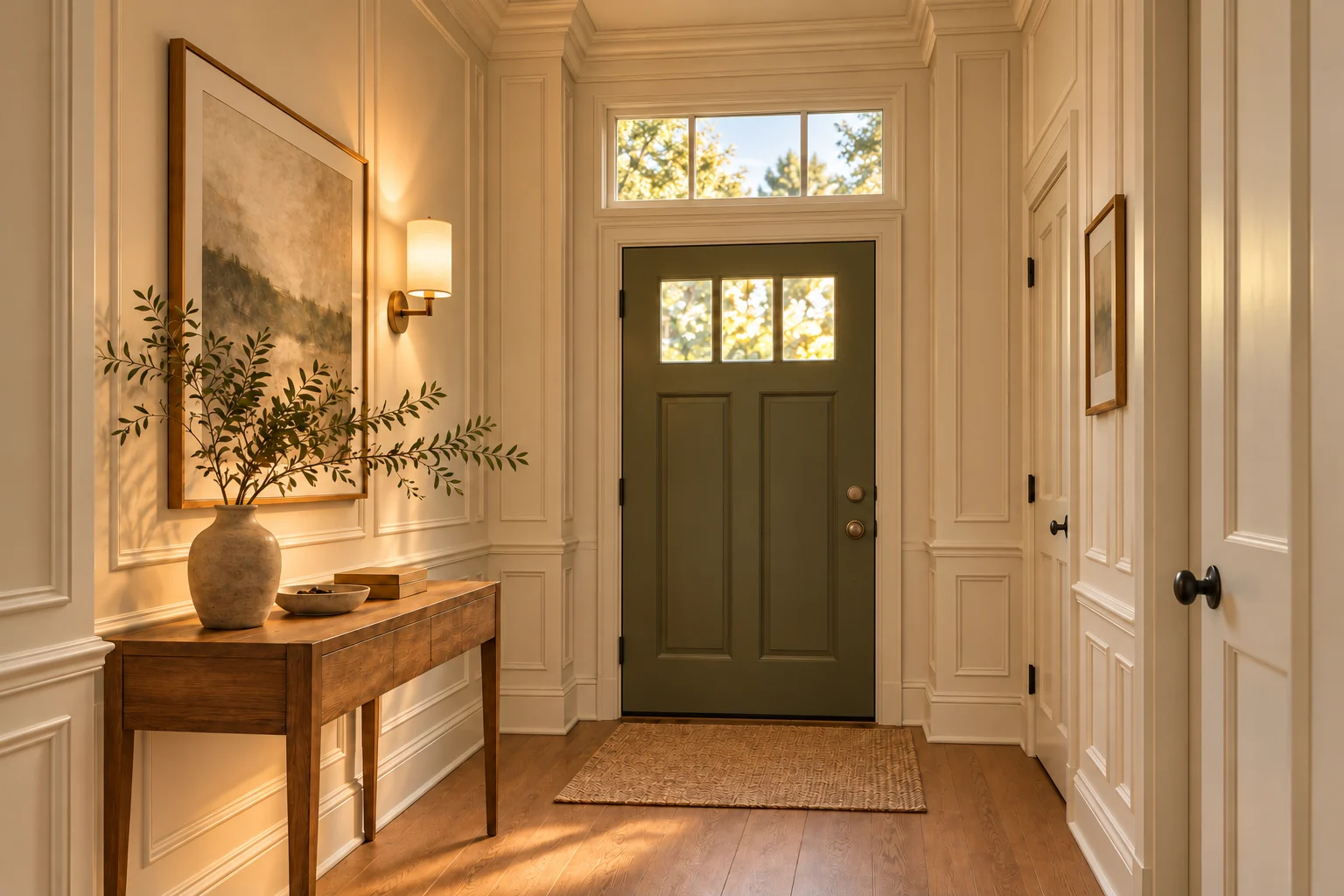
Once the practical pieces are in place, give the entryway a single focal point. A favorite print, a mirror, or an interesting wall light can provide enough character without using the landing surface.
Choose the piece you genuinely like, then leave visible wall around it. Several small pictures can work beautifully, but a compact entrance does not need a gallery arrangement to feel finished. Try one artwork you already own before buying a set.
If you choose a mirror, check what it reflects from the doorway. A view toward daylight or a calm part of the room can be pleasant; a reflection of shoe piles repeats the busiest part of the space. Mount mirrors and artwork securely using fixings suitable for their weight and the wall, following the manufacturer’s guidance.
This is the same attention to scale and breathing room that helps make a home look more expensive. A few well-placed details can give everyday furniture a more considered setting.
Add warmth through texture and light
Warmth can come from the things an entryway already needs. A woven mat, a wooden tray, a ceramic key dish, or a softly shaded lamp introduces texture without requiring a separate layer of ornaments.
Choose a small palette that connects with the adjoining room. Cream with warm wood, muted green with brass tones, or a soft neutral paired with black can feel coherent without every finish matching. Repeat one material or color and let the rest remain quiet.
Check a mat with the door open and closed, and choose one that stays secure without curled edges. Keep lighting cords out of the walking route. If there is no comfortable space or suitable outlet for a lamp, work with the existing ceiling light and a compatible bulb that gives a welcoming level of illumination.
Carry the same restraint into neighboring spaces. Our guide to making a small bedroom feel bigger explores how clearer routes and calmer surfaces can help the rest of the home, too.
Finish with a reset you can keep
Live with the arrangement for a few days before adding anything else. Notice which items return to the floor and which storage spots go unused. Move the solution closer to the habit: a hook within reach or a drawer that opens easily can be more useful than another organizer.
Then make the reset simple. Return shoes, clear the mail tray, and put keys in their usual place. Leave enough of the landing surface empty to receive tomorrow’s bag. A welcoming entryway is one that makes coming home feel natural, with a little space ready for you.